Climate
The expansion of electricity generation from wind and solar power contributes to the phase-out of fossil fuels. As a result, Eolus’s core business helps reduce greenhouse gas emissions to land, air, and water, thereby mitigating climate change.
However, building energy parks with wind power, solar power, and battery energy storage is not climate-neutral. This means that we must also actively work to reduce the climate impact of our own operations.
As part of our sustainability strategy, Eolus has set a target to achieve net-zero greenhouse gas emissions by 2040. This means that the total emissions from Eolus’s operations and across our entire value chain should be balanced by the amount of greenhouse gases removed from the atmosphere. Eolus’s ambitions are well aligned with the goals of the Paris Agreement.
Net-Zero Emissions by 2040
Although Eolus contributes to reducing emissions through the expansion of renewable energy generation, we are also working to reduce emissions from our own operations, with the goal of achieving net-zero greenhouse gas emissions by 2040.
Eolus intends to join the Science Based Targets initiative (SBTi) in the future. This would involve committing to a science-based emissions reduction target aligned with the goals of the Paris Agreement. As part of this effort, we have mapped the greenhouse gas emissions generated by our operations and throughout our value chain. These emissions are reported annually in our Annual and Sustainability Report.
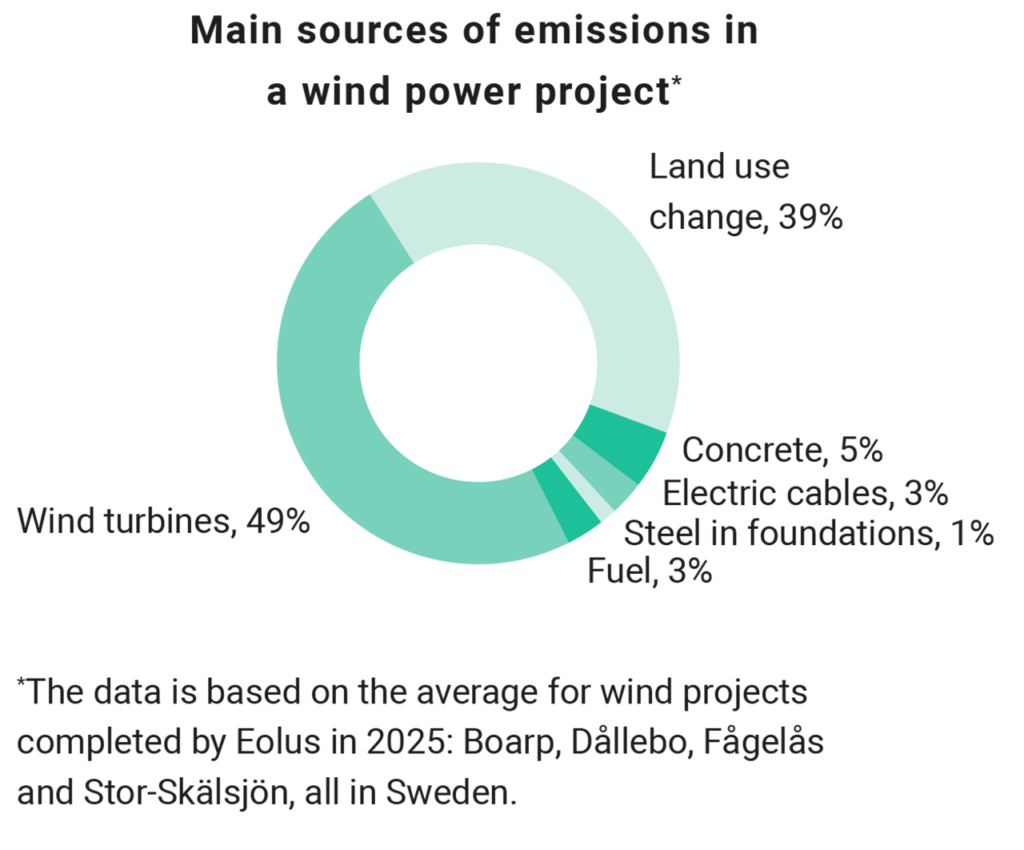
Distribution of emissions
The main sources of greenhouse gas emissions are the manufacture and installation of wind turbines, together with land-use changes resulting from the development of energy parks.
Through conscious design choices and optimisation of our energy parks, we seek to minimise the land area required, thereby limiting emissions associated with land-use change.
Further reductions in emissions from manufacturing and construction will depend on technological advances and the broader commercial availability of fossil-free steel and other low-carbon materials. We closely monitor these developments and engage in continuous dialogue with our suppliers. Low-carbon footprint concrete is already being used in projects.

Case Study - The World's First Climate-Neutral Seabed Survey
In 2023, the first climate-neutral* seabed survey for offshore wind power was conducted. In the Finnish project Wellamo, the seabed survey was carried out by Clinton Marine Survey, using ships powered by the completely renewable and fossil-free fuel HVO100.
“With technology that allows us to use smaller ships and fossil-free fuels, we can make the survey climate-neutral,” says Philip Ljungström, Project Manager at Clinton.
Picture from Clinton Marine Survey
The shipping involved in the measurement, construction, and maintenance of offshore wind farms is an unavoidable environmental risk. However, with ships powered by HVO100, the impact is significantly reduced. HVO stands for Hydrotreated Vegetable Oil and is a renewable fuel for diesel engines. The fuel can be made from various raw materials such as vegetable oils and animal fats, which are processed to become diesel engine fuel. Typically, according to Clinton Marine Survey, 6,000 to 10,000 liters of diesel are used per day during a seabed survey.
“According to our calculations, we saved between 500 and 845 tons of CO2e in the Wellamo project,” says Philip Ljungström.
*HVO100 reduces greenhouse gas emissions by 90 percent according to the manufacturer Neste. The remaining 10 percent CO2e is compensated by Clinton. This is primarily done through the planting of mangrove trees. In cases where this is not possible, Clinton uses HVO100 in another project to compensate for the remaining 10 percent. This is possible because not all projects run on HVO100 today, due to the higher cost of the fuel.
** The calculation is performed through a comparison of emissions with the number of liters of diesel that would have been used if HVO100 had not been utilized.